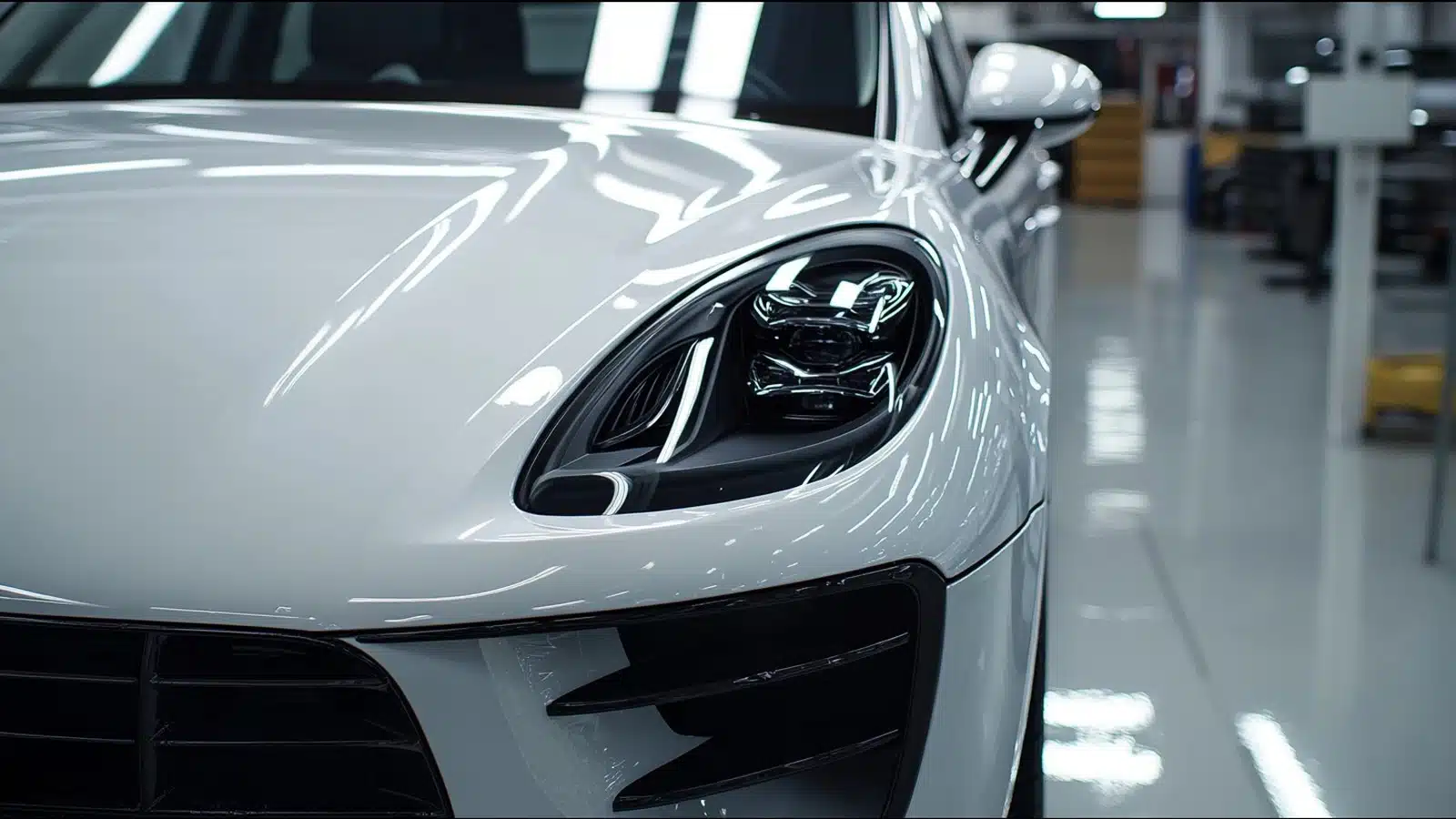
“Can I just do ceramic instead of PPF?” comes up in almost every paint protection quote we write in Hackensack. They get sold as if they were two versions of the same thing. They aren’t. Rather than give you our opinion, here is what the manufacturers publish about each product, what the numbers say about a car driven on North Jersey roads, and how the shop handles each one.
Two products, two different jobs
Paint protection film is a sheet of clear polyurethane that is cut and applied over the paint. 3M’s product bulletin for its Scotchgard PPF puts the film at 8.0 mils (0.20 mm) with adhesive, and describes it as designed to protect paint from “stone chips, scratches, bug damage, road tar, stains, automotive fluid stains and punishing outdoor weathering including harsh ultraviolet (UV) radiation.” The current Pro Series 200 adds self-healing: minor scratches and marks come out when heat is applied to the film surface.
A ceramic coating is a liquid that is wiped onto the paint and cures into a hard, glassy layer. One published technical data sheet for a professional coating lists a cured film thickness of 600 to 800 nanometers, which is 0.6 to 0.8 of a micron, a pencil hardness of 9H, and durability of “up to 7 years with condition of proper maintenance.” The coating’s job is chemical resistance and water repellency: bird droppings, bugs, tar and road grime don’t bond to it the way they bond to bare clear coat, and the car stays cleaner between washes.
The thickness numbers settle most of the argument
Put the two side by side and the difference is about 250 to 1. PPF is roughly 200 microns thick. A ceramic coating is under one micron. For reference, the clear coat on a factory paint job usually measures 35 to 50 microns, inside a total paint build of about 100 to 180 microns, according to DeFelsko’s published gauge guidance.
So a ceramic coating is thinner than the clear coat it sits on. It is a hard surface, not a cushion, and a stone thrown up at 65 mph on Route 17 goes through it and into the paint the same way it would without the coating. The film is a different matter: 200 microns of urethane absorbs that strike, and on a self-healing film the mark closes up with heat.
| Paint protection film | Ceramic coating | |
|---|---|---|
| What it is | Clear polyurethane sheet, applied panel by panel | Liquid that cures to a glass-like layer |
| Thickness | 8.0 mils, about 200 microns | 0.6 to 0.8 microns |
| Against factory clear coat (35 to 50 microns) | About 4 to 6 times thicker | Thinner than the clear coat |
| Maker’s stated protection | Stone chips, scratches, bug damage, tar, stains, UV | Chemical resistance, gloss, hardness, water and oil repellency |
| Rock chips | Named in the product description | Not claimed |
| Self-healing | Yes, minor scratches with heat (Pro Series 200) | No |
| Published life | 10-year consumer warranty | Up to 7 years with proper maintenance |
| Full cure | Adhesion builds over the first week, no wash for 72 hours | Initial cure 2 to 5 hours, full cure 14 days |
What a New Jersey car actually faces
The published numbers for our area make the choice more concrete. Using NOAA’s 30-year normals for Newark, we get 79.9 days a year at or below freezing and 31.5 inches of snow. NJDOT reported spreading 238,480 tons of road salt plus 427,180 gallons of liquid calcium chloride in the 2021-22 season. The grit that goes down with that salt is what gets thrown at the front of your car by the truck ahead of you on Route 4, Route 17 and the Turnpike from November through March.
Match each kind of damage to what the manufacturers say their product does, and the split is clean.
| Damage | Where it comes from | PPF | Ceramic coating |
|---|---|---|---|
| Rock chips on the nose | Winter grit and highway debris | Yes, named use | No |
| Light scratches and swirls | Brush car washes, wiping dry grit | Yes, self-healing with heat | Hardness helps, but no self-healing |
| Bird droppings, bugs, tar | Year round, worst in summer | Yes, stain resistance, clean off early | Yes, the coating’s main job |
| Salt and road grime sticking | November to March | Film takes it instead of paint, rinse it off | Yes, sheds water and grime |
| UV fading | Summer sun, outdoor parking | Yes, named use | Yes, UV resistance is claimed |
Read that table from the top. If chips on the bumper and hood are what you’re trying to prevent, only one of the two products claims to do it. If your car lives in a garage, sees little highway and your problem is keeping it clean and glossy, the coating is doing the job you’re paying for.
They are not either-or
3M’s own maintenance guidance for its film says a ceramic coating “can be applied for additional hydrophobicity, stain resistance, and easy clean features” on top of the PPF. That combination is common in our shop: film on the front end or the whole car, coating over everything. The film takes the hits, the coating keeps the film and the rest of the paint easy to wash.
The one thing not to put on either product is an abrasive. The same 3M bulletin says not to use “waxes containing dyes, abrasive polishes, and/or rubbing compounds” on the film, because the particles damage the surface.
What each one involves at our shop
These are shop figures, not manufacturer figures. Full body PPF ties the car up for about a week. A full front (bumper, hood, fenders and mirrors) takes about three days. A ceramic coating on its own is three days as well.
On warranty: our PPF carries 3 years on the workmanship on top of the film maker’s 10-year coverage. Our ceramic coating carries a lifetime warranty on the water-beading properties, and the condition is a yearly inspection at the shop. Every job, film or coating, gets a look at one month and then once a year after that.
Care is the same for both and comes from the manufacturers: hand wash when you can, touchless if it has to be a car wash, get bird droppings and bugs off early, and don’t wash at all for the first few days after the work is done. We covered the film side in detail in how to care for PPF.
Common questions
Does a ceramic coating stop rock chips?
The manufacturers don’t claim it does. The coating is under a micron thick, thinner than your clear coat. Chip protection is the film’s job.
Is a 9H coating harder than PPF?
Yes, and that’s the point of each product. The coating is hard and thin, which is good for resisting chemicals and light marring. The film is soft and thick, which is what absorbs an impact. Hardness and impact protection are different properties.
Can I put ceramic coating over PPF?
Yes. 3M lists a ceramic coating as an approved topper for its film, and it’s a common combination in our shop.
How long does each one last?
The film we install carries a 10-year manufacturer warranty. The published data sheet for a professional ceramic coating says up to 7 years with proper maintenance, and our coating warranty is tied to that yearly inspection. Either way, how the car is washed matters more than the calendar.
Which one should I get first?
Work out what damage you’re actually seeing. Chips on the nose point to film, at least on the front end. A garaged car that just gets dull and dirty points to the coating. Send us the year, model, where it’s parked and how much highway it sees, and we’ll tell you which one fits, or whether it’s both.
If you want a read on your own car, text or call the Hackensack shop at (201) 379-0902, or send the form with a couple of photos of the paint as it is now.
Sources: 3M Scotchgard Paint Protection Film Pro Series product bulletin (thickness, uses, warranty) and Pro Series 200 bulletin (self-healing, approved coatings, what not to use); 3M protection film maintenance FAQ (washing); Onyx Quartz Pro ceramic coating technical data sheet (film thickness, hardness, durability, cure times); DeFelsko paint thickness guidance (factory paint and clear coat thickness); NOAA 1991-2020 climate normals, Newark Liberty; NJDOT winter expenditures. Turnaround times, warranty terms and inspection schedule are illmatic Wraps’ own. Coating specifications vary by brand; the data sheet cited is one published example. Last reviewed September 2026.
More from the blog
Ceramic coating over a vinyl wrap: what 3M, Avery Dennison and KPMF each say
Search for whether to put a ceramic coating on a vinyl wrap and almost every answer is written by someone…
Read more
Caring for a matte or satin wrap, and what the film makers actually say
A satin or matte wrap looks the way it does because the surface scatters light instead of reflecting it. Everything…
Read more
New Tesla in New Jersey, what to check on delivery day and when to book film
NJ sales tax, inspection, Lemon Law and tint rules for a new Tesla, what to check on the paint at…
Read more