If you drive a BMW in North Jersey, the question of whether to put film on before winter comes up every fall. Rather than give you our opinion, here is what the published record says: what the state actually puts on the roads, what BMW’s own warranty covers and excludes, and what the film manufacturers specify about temperature. The figures below are all from those sources, linked at the end.
What a New Jersey winter looks like in numbers
Using the 30-year normals for Newark, we average 31.5 inches of snow a year and 79.9 days where the low drops to freezing or below. The first freeze of the season has a 50% chance of arriving by November 10. So the season is underway by early November, not January.
The salt numbers are bigger than most people expect. NJDOT reports its winter materials by season: 238,480 tons of salt plus 427,180 gallons of liquid calcium chloride in 2021-2022, and 82,129 tons in the much lighter 2022-2023 season. The state keeps 68 salt storage facilities and can stockpile up to 228,000 tons.
| Measure | Figure |
|---|---|
| Annual snowfall, Newark | 31.5 inches |
| Days at or below freezing | 79.9 per year |
| First freeze, 50% probability | November 10 |
| Road salt applied | 238,480 tons in 2021-22, 82,129 tons in 2022-23 |
| Liquid calcium chloride | 427,180 gallons in 2021-22 |
Salt doesn’t eat your clear coat. It attacks what’s under the chips
You’ll hear that road salt eats paint. The published material doesn’t support that. Intact clear coat doesn’t dissolve in brine. What the corrosion literature describes is chloride reaching bare metal through paint that’s already broken: a rock chip on the bumper, a door ding, a scrape inside the wheel arch.
BMW’s own paperwork lines up with this. BMW of North America warrants the body against rust perforation for 12 years, unlimited mileage. The paint finish itself is a different story. The warranty booklet lists as not covered: “Damage to the paint finish due to stone chips, nicks, dents, acid rain, industrial fallout, other environmental influences, and normal deterioration, such as fading, discoloration, or loss of luster.” Road salt corrosion appears in the exclusions too.
Read together, those two terms draw a clear line. A hole rusting through from the inside is covered for 12 years. The chip that let the salt in is not covered at all. That distinction, not anyone’s sales pitch, is what makes the timing of film a practical question.
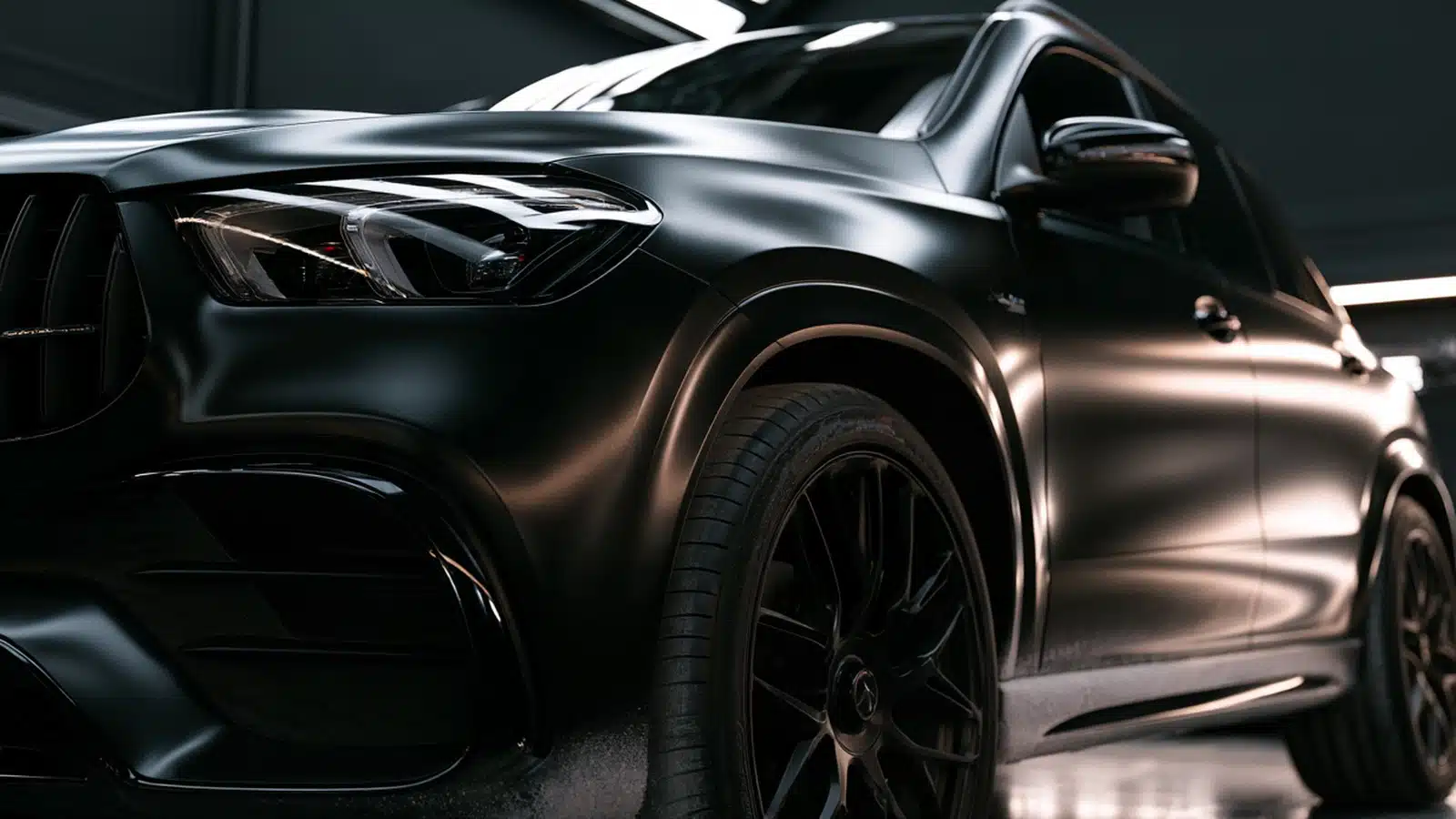
If your car has Frozen or matte paint, the stakes are higher
The same exclusion list has one more line worth reading twice: “improper care/repair of matte paint finishes, as well as damage caused by lack of maintenance, excessive rubbing, the use of improper cleaners, polishes and/or waxes.”
On gloss paint, light swirls can be polished out. On a matte or Frozen finish that route is closed: rubbing one spot brings up gloss right there. BMW Group’s own guidance on its matte finishes says spot cleaning the surface with wax or polish “can leave an unwanted gloss effect.” So for a matte car the usual correction option is off the table, which is worth knowing before the salt season rather than after it.
Wrap or PPF, judged on winter alone
The two films are built for different jobs, and the manufacturers describe them that way. PPF is thick clear urethane made to absorb rock strikes. Vinyl wrap is a color film. Judged on winter alone, the distinction decides it.
| PPF | Vinyl wrap | |
|---|---|---|
| Main job | Protecting the paint | Changing the color |
| Rock chips | Absorbs them | Not what it’s built for |
| Where it matters most | Front bumper, hood, fenders, mirrors | Whole car, or a panel |
| Manufacturer rating | Warranted up to 10 years | Cast film rated 8 years of expected performance life on a flat vertical surface, which the maker states is not a warranty |
| Removal in the cold | We handle it when it’s due | Film turns brittle as temperatures drop |
If chips are the worry, PPF is the product built for it, and the front end is where winter does most of its work. We covered full front versus full body separately.
The install needs temperature too
This is the part most people don’t know, and it isn’t a matter of opinion: the film manufacturers publish minimum temperatures. 3M lists an application temperature of 65°F to 75°F (18°C to 24°C) for its wrap film. Avery Dennison gives a minimum application temperature of 50°F (10°C), rising to 60°F (16°C) for complex curves.
Removal has a floor as well. 3M’s removal bulletin says finished graphics “can become brittle in cooler temperatures causing it to break into small pieces during removal” and to remove film when the temperature is above 64.4°F (10°C). In practice the film gets heated to 160°F to 200°F to come off cleanly.
What this means in practice is that a January install needs a heated indoor space to meet the manufacturer’s own specification. Our bay in Hackensack is climate controlled, but the point holds wherever you go: it’s a fair question to ask any shop you’re getting a winter quote from.
Looking after film through a winter
Film doesn’t mean you stop washing the car. These are the manufacturer’s own instructions, not shop preference.
- Don’t wash the car for 72 hours after installation
- Hand wash when you can. If it has to go through a car wash, pick a touchless one: brush washes dull and scratch film and can lift an edge
- Keep a pressure washer to 1,200 psi maximum and never aim it straight at a film edge. Too much pressure forces water under the film and weakens the bond
- Rinse salt and grit off first, then wipe. Wiping dry grit across film drags it over the surface and scratches it
One more from BMW’s booklet, and it applies whether or not you have film: “The underbody has to be cleaned at least once a year, in Spring, with plain water in order to remove mud, chemical sediments and other deposits.”
When to book it
With the first freeze landing around November 10 on average, October into early November is the natural window. Full body PPF ties the car up for about a week in our shop and a full front takes about three days, so count backward from when you want it done.
If winter has already started, it isn’t too late, but there’s an extra step. The car has to be washed down properly and the paint looked over before any film goes on, because film seals in whatever is underneath it.
Common questions
Is BMW paint especially vulnerable in winter?
What matters is whether the paint is already broken, not the badge. BMW covers rust perforation for 12 years but excludes paint damage from stone chips. If the nose of your car already has chips, that’s where winter goes to work first.
My car has Frozen matte paint. Can’t I just polish the swirls out?
BMW lists improper care of matte finishes, excessive rubbing and improper polishes among the things its warranty does not cover. Polishing a matte panel brings up gloss where you worked it, and there’s no easy way back.
Can you wrap a car in winter?
Indoors with the temperature controlled, yes. 3M calls for 65°F to 75°F and Avery sets a 50°F minimum, so the question is whether the space can hold that, not what month it is.
Does film mean I can skip washing in winter?
No. Film takes the salt instead of your paint, it doesn’t repel it. 3M’s guidance is to rinse salt and dirt off rather than wipe them across the surface, because the grit itself scratches film.
Can I have old film removed in the winter?
Not in the cold. 3M says to remove film above 64.4°F because cold film breaks into pieces and turns a clean job into a long one. Done indoors with heat, it’s fine.
If you want a read on your own car rather than the general case, send us the year, the model and how the paint looks now, or bring it by the Hackensack shop. Text or call (201) 379-0902.
Sources: NOAA 1991-2020 U.S. Climate Normals, station Newark Liberty USW00014734; NJDOT winter expenditures and NJDOT winter readiness FAQ; BMW of North America Service and Warranty Information booklet (2022 X series), rust perforation and exclusions, quoted verbatim; BMW Group press material on its matte finishes; 3M Wrap Film Series 2080 product bulletin (application temperature), 3M graphics removal bulletin (removal temperature), 3M protection wrap film maintenance FAQ (washing and pressure limits); Avery Dennison Supreme Wrapping Film data sheet. Turnaround times and shop practice are illmatic Wraps’ own. Warranty terms vary by model year and vehicle, so check the booklet that came with your car. Last reviewed September 2026.
More from the blog
Caring for a matte or satin wrap, and what the film makers actually say
A satin or matte wrap looks the way it does because the surface scatters light instead of reflecting it. Everything…
Read more
Car wraps in Danbury CT: what the winter here does to your paint
Danbury sits inland and up in the hills, and the weather record shows it. The nearest official station records 133.7…
Read more
Car wraps in North Jersey: what the roads here do to your paint
North Jersey is not the same driving environment as the rest of the state, and it is not the same…
Read more