Short answer: no. Wrapping your Tesla, or putting paint protection film on it, does not void the warranty. Not the basic vehicle warranty, not the battery and drive unit warranty. There’s no clause in Tesla’s warranty terms that says film on paint cancels your coverage, and no federal law would let a manufacturer enforce one if there were.
That said, the question isn’t silly. It’s the single most common worry we hear from Tesla owners in North Jersey before a wrap job, usually phrased as “my car’s barely a year old, am I about to throw away the warranty for a color change?” So here’s the full picture, including the two situations where an installer really can cost you money.
What Tesla’s warranty actually covers, and what a wrap touches
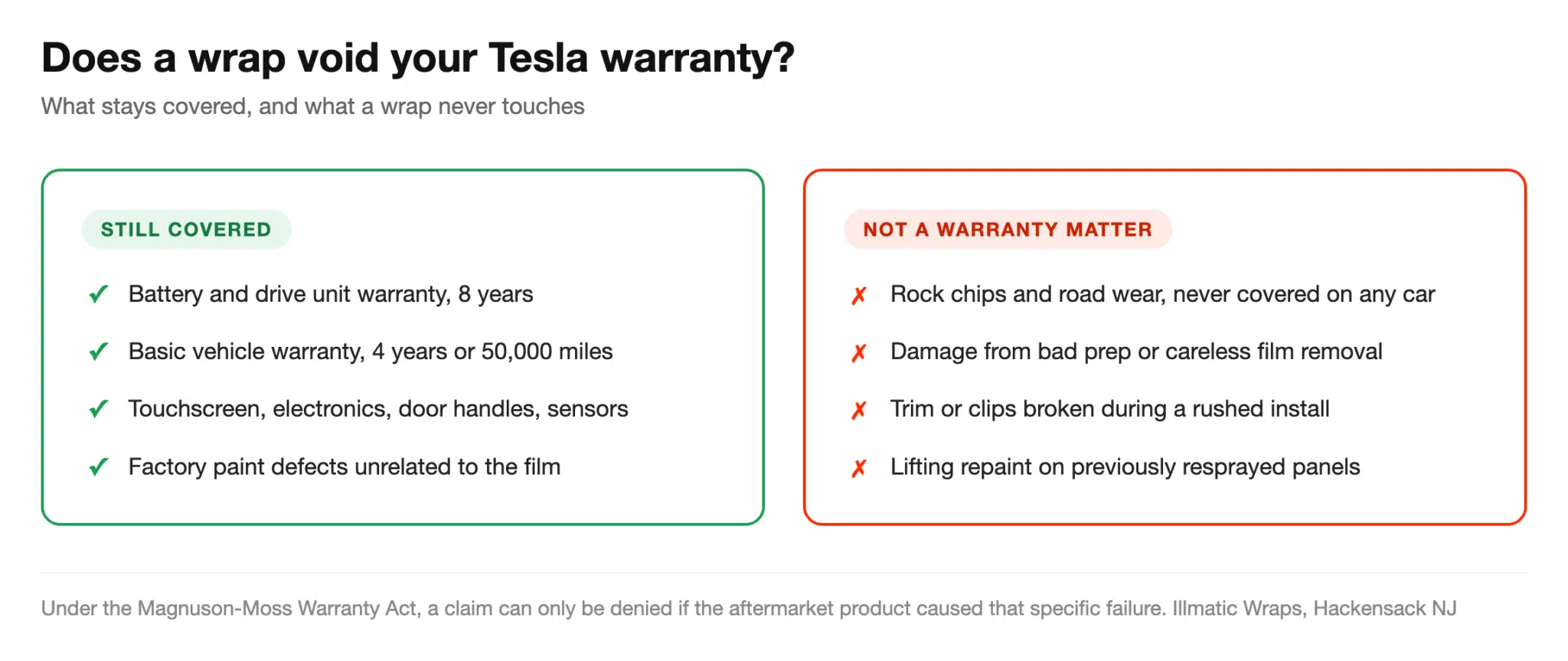
Tesla’s New Vehicle Limited Warranty has two main parts. The basic warranty runs 4 years or 50,000 miles and covers defects in materials and workmanship. The battery and drive unit warranty runs 8 years and between 100,000 and 150,000 miles depending on the model.
A vinyl wrap or PPF install touches exactly one thing: the painted surface. It doesn’t open the battery pack, doesn’t touch the drive units, doesn’t plug into the electrical system. The film sits on top of the clear coat and comes off the same way. So even in the worst imaginable case, the only coverage that could ever be in question is paint related, and Tesla’s paint coverage is already narrow. Factory paint defects get handled under the basic warranty; rock chips and road wear never were covered, film or no film.
The federal law that protects you
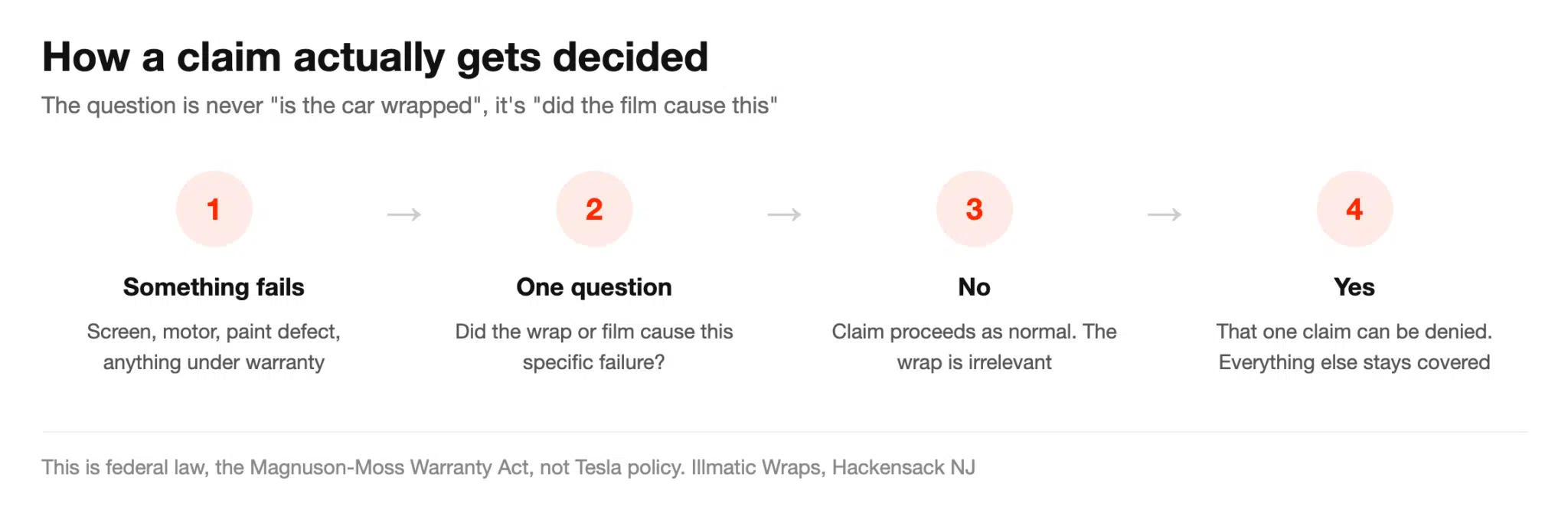
In the United States, the Magnuson-Moss Warranty Act draws the line. A manufacturer can’t void your whole warranty because you added an aftermarket product. What it can do is deny a specific claim if it can show the aftermarket product caused that specific failure.
Apply that to film and the logic gets simple. If your Tesla’s touchscreen fails, the wrap is irrelevant, and Tesla can’t point at it. If a door handle motor dies, same thing. The only claim where film could even enter the conversation is a paint claim, and only if Tesla could show the film or its removal caused the damage. Which brings us to the part that actually matters.
The two real risks, and both are about the installer
The warranty question is mostly a stand-in for a better question: can a wrap job damage my car? A proper install can’t. A careless one can, in two ways.
Bad prep or bad removal. Tesla paint is on the thinner and softer side. We’ve measured it panel by panel, and it reads at the low end of the normal range for a modern car. That’s not a reason to avoid wrapping a Tesla. If anything it’s the argument for film, since the factory paint needs the help. But it does mean aggressive scraping, harsh solvents, or ripping film off cold can pull clear coat with it. Damage like that isn’t a warranty problem, it’s an installer problem, and Tesla is right to refuse it. So would any manufacturer.
Disassembly done wrong. Full wraps involve removing or loosening trim, badges, door handles and sometimes camera housings so the film can tuck cleanly. On a Tesla, several of those parts have wiring or sensors behind them. A shop that’s never worked on one can crack a clip or unplug something it shouldn’t. Again, that’s damage, not a warranty voiding event. But it’s real money and a real argument, and it’s avoidable by asking one question before you book: how many Teslas has this shop actually wrapped?
What about the paint under the film years later
The opposite of the fear is closer to the truth. Paint that spends five years under quality film comes out looking newer than paint that spent those years bare, because the film took the UV, the rock chips and the bird droppings instead of the clear coat. Quality PPF and wrap films are engineered to release from automotive paint when heated and pulled at the correct angle. The films we install carry manufacturer-backed durability ratings, and removal at the end of the film’s life is part of what they’re designed to do.
The one honest caveat: film should go on healthy factory paint. If a panel has been resprayed after bodywork, fresh paint needs time to cure before film goes over it, and a repaint that was thin or poorly bonded can lift when any film comes off. A good shop checks for this with a paint depth gauge before quoting, which takes about two minutes per car.
Does a wrap affect the battery warranty or leased Teslas
The battery and drive unit warranty is untouched by anything that happens to the body surface. Film adds a few kilograms at most, spread over the whole car. It has no effect on range worth measuring and no connection to the drivetrain coverage at all.
Leased Teslas are a slightly different conversation. The warranty logic is identical, but the lease return inspection cares about the car coming back in original condition, so the film needs to come off before return and the paint underneath needs to be clean. That’s a planning question more than a risk. We cover the lease return process in detail in our lease return guide.
How we handle Teslas specifically
Our shop is in Hackensack and Teslas are a large share of what rolls through the bay, mostly Model 3 and Model Y from Bergen County and the surrounding towns. The process reflects the paint measurements above: gauge readings before we quote, low-tack prep chemistry, panels warmed before any film comes off, and disassembly done by people who have had those exact trim pieces off dozens of times. If you want the numbers behind why Tesla paint needs the extra care, we published our gauge readings in a separate post.
Common questions
Does wrapping a Tesla void the warranty?
No. A vinyl wrap or paint protection film does not void Tesla’s basic vehicle warranty or the battery and drive unit warranty. Under the Magnuson-Moss Warranty Act, a manufacturer can only deny a claim if it shows the aftermarket product caused that specific problem.
Can Tesla refuse a paint warranty claim because of a wrap?
Only if the film or its removal caused the damage being claimed. A factory paint defect that has nothing to do with the film stays covered. Damage from a careless install was never a warranty matter in the first place; that’s on the shop that did the work.
Does PPF damage Tesla paint when it’s removed?
Not when it’s installed on healthy factory paint and removed properly, with heat and the correct pulling angle. The known exception is resprayed panels, where thin or poorly cured repaint can lift with any film. A shop should check paint condition with a depth gauge before installing.
Does a wrap affect Tesla battery range or the battery warranty?
No. Film adds a few kilograms spread across the body, which has no measurable effect on range, and the battery and drive unit warranty covers components a wrap never touches.
Should I tell Tesla my car is wrapped?
There’s nothing to report and no registration involved. If the car goes in for body-related service, mention it so the service center handles the panels accordingly, the same way you’d mention it at a car wash.
Thinking about wrapping or protecting your Tesla and want it done by people who work on them every week? Send us a few photos through the quote form and we’ll come back with a real number, usually the same day.
Sources: Magnuson-Moss Warranty Act, Federal Trade Commission and 15 U.S. Code 2302, Cornell Law School. Warranty terms are Tesla’s published New Vehicle Limited Warranty; check your own car’s warranty booklet for the version that applies to it.
More from the blog
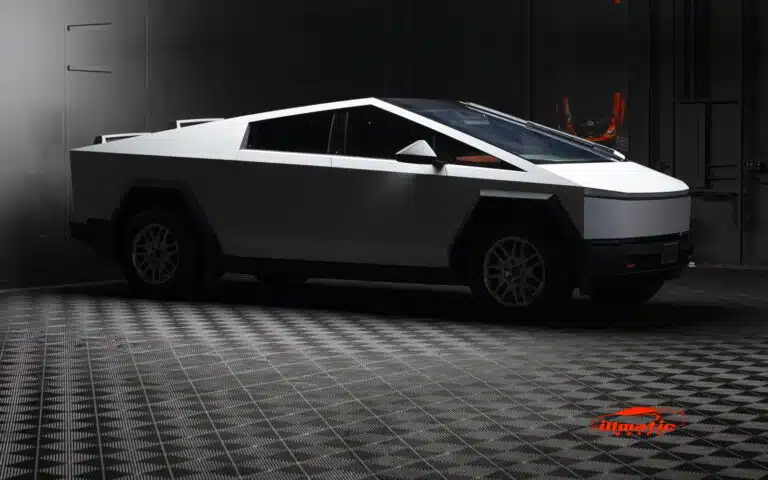
Caring for a matte or satin wrap, and what the film makers actually say
A satin or matte wrap looks the way it does because the surface scatters light instead of reflecting it. Everything…
Read more
Car wraps in Danbury CT: what the winter here does to your paint
Danbury sits inland and up in the hills, and the weather record shows it. The nearest official station records 133.7…
Read more
Car wraps in North Jersey: what the roads here do to your paint
North Jersey is not the same driving environment as the rest of the state, and it is not the same…
Read more