Short answer: yes. Put a paint depth gauge on a Tesla and the numbers come in lower than on most cars parked next to it, usually at the low end of the normal range for a modern car. Run the same gauge over a BMW, a Lexus or a Mercedes and the readings usually come in higher.
That gap is small in absolute terms. About the width of a human hair. But it sits in exactly the place where rock chips happen, and Tesla owners in North Jersey feel it faster than most, for reasons that have as much to do with Route 17 as with the factory.
Here’s what’s actually going on, and what does and doesn’t help.
What the gauge readings show
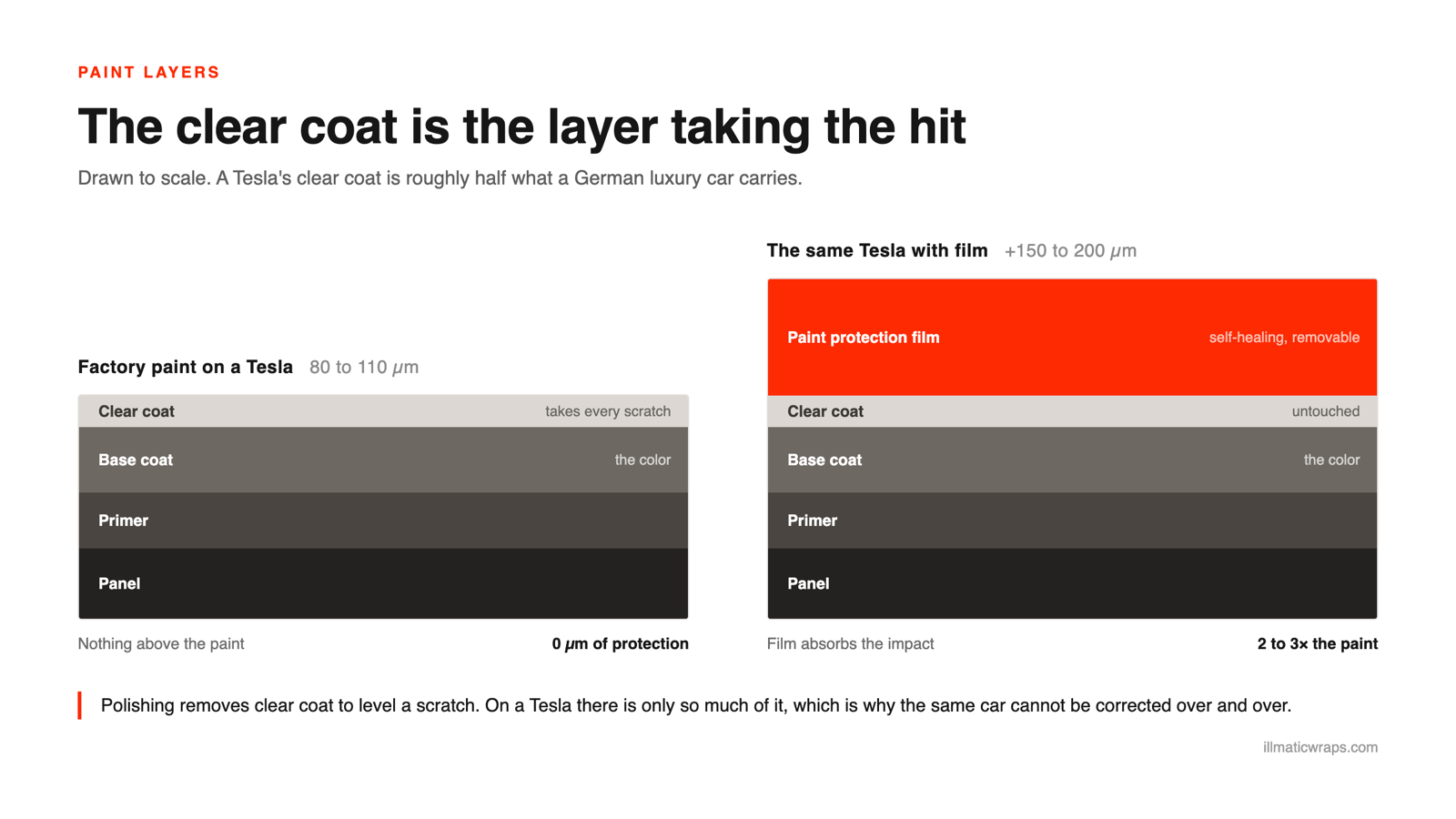
Paint isn’t one layer. It’s primer, then base coat for color, then clear coat on top. A depth gauge reads all of it at once and gives you a single number in microns. The clear coat is the part that matters for chips and scratches, because it’s the layer taking the hit.
Published measurement tables from the instrument makers give you a sense of the normal range. Published gauge data puts a factory finish at roughly 90 to 180 microns of total film build depending on the car, with German SUVs often at the top of that band and small Japanese cars near the bottom. Tesla doesn’t appear in those tables, so the numbers that circulate come from detailers and installers who gauge every car before they touch it.
Those readings are consistent enough to take seriously. Owner gauge readings posted online put Teslas toward the bottom of that band, below the German cars measured alongside them. Treat those as one owner’s numbers, not a study: no manufacturer publishes paint thickness, and no independent survey of Tesla paint exists. We see the same thing on the cars that come through our studio.
One caveat worth knowing before you go buy a gauge. Readings move around depending on where you measure, and panels that have been repainted after a body shop visit will read much higher than factory. Measure the roof if you want a baseline, since it’s the panel least likely to have been touched.
| Vehicle | Total paint | Clear coat |
|---|---|---|
| Tesla | Toward the bottom of the range, from owner readings | No published manufacturer figure exists |
| Factory paint, all makes | About 90 to 180 total | Clear coat roughly 35 to 50 of that |
| Paint protection film | 150 to 200 | The film alone is thicker than the entire factory paint |
Sources: PPG Refinish OEM film builds (about 90 to 120 microns), DeFelsko paint thickness guide (100 to 180 microns, clear coat 35 to 50) and the 3M Scotchgard Pro Series 200 technical data sheet. Individual cars vary panel to panel.
Why Tesla paint is built this way
Two things drive it, and neither is an accident.
The first is chemistry. Tesla uses water-based paint. It’s better environmentally than the solvent-based systems a lot of older lines still run, and it’s the direction the whole industry is heading. It also cures softer. A softer clear coat marks more easily, which is why Teslas swirl so readily in an automatic car wash and why a fingernail catches on damage that would have buffed out of a harder finish.
The second is line speed. Every extra micron of clear coat is time in the booth and time in the oven. Tesla builds cars fast, and the paint shop is where that shows up. Owners have noticed differences between cars from different factories, and newer colors introduced with newer paint shops have generally been better regarded than the early ones.
So it isn’t that the paint is defective. It’s thin and soft by design, and those two properties compound each other.
Thickness isn’t the whole story
People fixate on the micron number, but hardness matters just as much. A thin, hard clear coat can outlast a thicker soft one against fine scratching. Tesla happens to be on the wrong side of both.
What that means in practice is that Tesla damage tends to come in two flavors, and they need different answers.
- Impact damage. Rock chips, mostly on the nose of the car. Something hits hard enough to go through the clear coat and the base coat down to primer or metal. No polish fixes this.
- Surface damage. Swirls, wash marks, light scratching. This lives in the clear coat and can often be polished out, but every polish removes clear coat you don’t have much of to begin with.
The second one is why we’re careful about correcting Teslas. Clear coat generally runs about 35 to 50 microns, and manufacturers advise removing no more than about 8 microns of it over the life of the car. On a Tesla you might be starting with 20. You get one or two proper corrections in the life of the car before you’re into the base coat, and then the only fix is paint.
Where Teslas actually get chipped
Chip damage isn’t random. It clusters, and on a Tesla it clusters harder than usual because of the shape of the car.
- Front bumper. The single worst area on every Model 3 and Model Y we see. It’s a large, near-vertical face pointed straight into everything the road throws up.
- Hood leading edge. The first eight inches or so. Debris that clears the bumper lands here.
- Mirror caps. Small parts, badly exposed, and annoying to repaint because of the color match.
- A-pillars and the leading edge of the roof. Highway-speed damage. The Model Y’s glass roof means the painted strip in front of it takes a beating.
- Rocker panels and the area behind the front wheels. Sandblasted by the front tires. On Teslas this shows up early because the cars are heavy and the tires throw a lot.
The North Jersey part of the problem
Where you drive matters more than most owners expect, and Bergen County is a rough environment for paint.
Route 17, Route 46, Route 80 and the Turnpike are all heavy truck corridors with a lot of surface repair going on at any given time. Loose aggregate off a construction zone at 60 miles an hour is what puts most of the chips in a car’s nose. Then winter arrives and the counties put down salt and sand, and the sand is the part that does the damage. It sits in the road for months and gets picked up by every car in front of you.
A Tesla that spends its life on local roads in Teaneck or Fort Lee will look very different at three years old than one commuting down 17 every morning. We can usually guess which is which before the owner tells us.
What actually stops it, and what doesn’t
This is where a lot of money gets spent on the wrong product, so it’s worth being blunt about what each one does.
Paint protection film stops chips
PPF is a thick urethane film, roughly 150 to 200 microns, laid over the paint. That’s more material than the entire factory paint system on a Tesla. A stone that would have chipped the paint hits the film instead and the film absorbs it. Modern films are self-healing, so light scratching in the film disappears with heat from the sun or warm water.
This is the only product that genuinely solves the chip problem. Everything else manages the symptoms.
Ceramic coating does not stop chips
A ceramic coating is measured in single-digit microns. It adds gloss, makes the car much easier to wash, and gives real protection against chemical staining and light marring. It will not stop a stone. Anyone telling a Tesla owner that ceramic replaces film is selling, not advising.
Ceramic on top of PPF is a good combination, though, and a lot of our Tesla customers end up there.
A vinyl wrap is styling that happens to help
Wrap film is thinner than PPF and it’s designed to change how the car looks, not to take impacts. It does shield the paint underneath from sun, light scratching and wash damage, and it comes off cleanly, which is why it works well on leased cars. But it won’t stop a highway stone the way film will.
If you want the color change and the chip protection, color PPF does both. It’s the more expensive path, and for a lot of Tesla owners it’s the right one.
How much coverage is enough
Full-body PPF is the complete answer, and plenty of owners do it. But you can get most of the benefit for a fraction of the cost by covering the zone where the damage actually lands.
Front bumper, full hood, front fenders and mirrors covers the large majority of chip damage on a Tesla. Adding the A-pillars and the leading edge of the roof handles the highway hits. Beyond that you’re protecting panels that rarely get struck, which is a fine thing to do if you’re keeping the car a long time and a poor use of money if you aren’t.
One detail people miss. A partial hood, where the film stops partway up, leaves a visible line and a hard edge that collects dirt. Full hood costs more and looks like nothing was done at all, which is the point.
If the paint is already chipped
Film goes over what’s there. It doesn’t repair anything, and it will lock in whatever the paint looks like on the day it goes on. Chips under film are more visible, not less, because the film magnifies slightly.
So the order matters. Touch in the chips, let them cure, do a light correction if the panel needs it, then film. On a car that’s already a few years into a hard commute, that sequence adds time and cost, which is the real argument for doing this while the car is new.
If you’re picking a car up from the delivery center, the ideal is film before the car has been washed even once. That isn’t always practical, and it’s not a disaster if it doesn’t happen, but the first few weeks are the cheapest weeks.
Common questions
Is Tesla paint defective?
No. It’s thinner and softer than most competitors by design, driven by water-based chemistry and a fast production line. That’s a durability tradeoff, not a defect, and it isn’t something a warranty claim will address.
Do some Tesla colors hold up better?
Chips happen the same on every color. What changes is how obvious they are. On black and the darker blues and grays, a chip shows the light primer underneath and stands out badly. White hides chips better than anything else in the range. Red shows swirl marks more than it shows chips.
Can I just polish the chips out?
No. Polishing removes clear coat to level the surface around a scratch. A chip has already gone through the clear coat, so there’s nothing to level. Chips need filling, not polishing.
Does film or wrap affect the sensors or cameras?
Not when it’s installed properly. Camera housings and sensor faces stay uncovered, and the film gets trimmed around them rather than over them. It’s a normal part of the job on every Tesla we do.
Will it void my Tesla warranty?
Adding film doesn’t void the vehicle warranty. Damage caused by a bad installation or a bad removal is a different question, which is the argument for having it done by people who work on these cars regularly. Tesla’s soft clear coat is easier to mark during installation than a harder finish, so it matters who does it.
Where this leaves you
The thin paint story is true, and it’s the reason Tesla owners show up at wrap shops earlier in the life of the car than owners of anything else. It’s also fixable, cheaply, if you deal with it before the chips arrive.
If you want to know what your car actually needs, bring it by the studio in Hackensack. We’ll gauge the paint, look at where the damage is landing, and tell you what coverage makes sense for how you drive. That conversation is free and takes about fifteen minutes.
Sources: PPG Refinish, OEM paint film builds, DeFelsko, automotive paint thickness gauges, 3M Scotchgard Paint Protection Film Pro Series product bulletin. Measurements at our shop are taken panel by panel at drop-off. Last reviewed September 2026.
More from the blog
Ceramic coating over a vinyl wrap: what 3M, Avery Dennison and KPMF each say
Search for whether to put a ceramic coating on a vinyl wrap and almost every answer is written by someone…
Read more
Caring for a matte or satin wrap, and what the film makers actually say
A satin or matte wrap looks the way it does because the surface scatters light instead of reflecting it. Everything…
Read more
Car wraps in Danbury CT: what the winter here does to your paint
Danbury sits inland and up in the hills, and the weather record shows it. The nearest official station records 133.7…
Read more